
Reciclaje/
En nuestra práctica profesional, distinguimos dos tipos de proyectos:
1. Los proyectos de obra nueva.
2. Los que se desenvuelven y articulan sobre preexistencias.
En ambos casos, el modo de intervenir es diferente. En los proyectos nuevos, la concepción surge a partir de variables externas a la materialidad y la mayoría de las decisiones se toman en diálogo con los clientes. Sin embargo, al entender que podemos hacer arquitectura con menos y contribuir al medio donde vivimos, enfocamos nuestros esfuerzos en conseguir materiales reciclables.
En el caso de proyectos determinados por preexistencias, lo primordial es la lectura de los restos materiales.
Reflexionamos sobre cómo transformar los ambientes de acuerdo con los recursos del lugar, intensificando nuestras acciones y buscando coherencia en la optimización. Es un acto de asimilación exhaustiva: comprender qué hay allí y cómo podemos transformarlo.
Tanto en obra nueva como en preexistencias, la hoja de ruta para incorporar materiales reciclados consiste en motivar a nuestra colectividad. Nos mantenemos receptivos a lo que nos ofrecen la comunidad cercana, amigos, familiares y clientes. Abrimos los ojos y extendemos los brazos —de manera conceptual— para alcanzar materiales que estén a la mano.
Consideramos que la construcción de objetos se puede realizar con una variedad de materias casi inimaginable; estamos abiertos a que así sea. Nos interesa obtener materiales desde la condición urbana, bajo la idea global de que la ciudad es una extensión rica, llena de sucesos y oportunidades. Con sus habitantes en movimiento, habitando y reformulando sus espacios, cada día surgen nuevas procedencias de materiales desechados que amplían nuestras posibilidades.
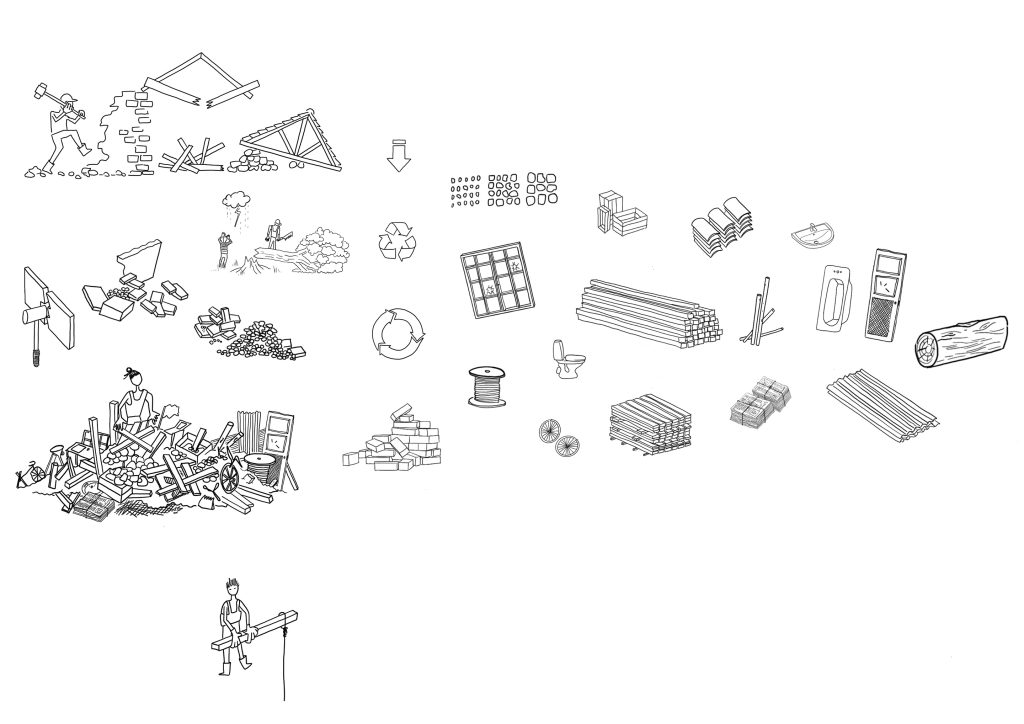
Hemos hallado formas de materia que han disparado nuestra capacidad de acción: troncos de árboles caídos para mesones de cocina, puertas de edificios remodelados que se convierten en «mesas voladoras», papel periódico para paredes, parabrisas rotos para mamparas, madera de casas demolidas para estructuras, tejas transformadas en pantallas divisorias, entre otros.
Hemos aprendido que los objetos aparentemente caducos contienen información valiosa y memoria intrínseca. Estas lógicas de reutilización responden a una mirada del mundo y a una actitud: desarrollar arquitectura sin priorizar lo económico, enfocándonos en la gestión y en hacer que las cosas resulten.
La manera de emplearlos varía según el material. Buscamos intervenir cada objeto con su propia lógica para que conserve su esencia y se exprese en su máxima potencia. Si utilizamos una rueda, queremos que se siga leyendo como tal, aunque esté descontextualizada; lo mismo ocurre con una silla, una puerta o un bailejo. En ocasiones, la repetición del material nos permite su sistematización; en otras, se trata de piezas únicas. Valoramos la imperfección: no pretendemos «perfeccionar» el objeto, sino que aceptamos su desgaste como un hecho del tiempo.
Cuando demolemos paredes en espacios existentes, estas se convierten en recursos valiosos que se reconfiguran en el mismo lugar desde su nueva condición de escombro. En ocasiones, las mismas herramientas de obra quedan en el espacio como elementos arquitectónicos, generando nuevas narrativas.
En nuestro ejercicio, los eventos constructivos deben quedar registrados como testimonio del esfuerzo del maestro y del diálogo entre el material y la mano del albañil. Es una expresión de la razón material. Respetamos vetas, trizaduras, desgastes y coloraciones. Valoramos el trabajo del artesano y entendemos la arquitectura como un hecho constructivo manual; por ello, cada pieza reciclada se coloca una por una.
Trabajar con materiales reciclados implica complejidad. Por un lado, el costo del material es cero, pero sus circunstancias exigen un trabajo adicional para poder emplearlo. Siempre habrá un esfuerzo en dar nueva vida a lo obsoleto, pero este proceso pone a prueba el pensamiento y otorga un nuevo orden que no habíamos concebido previamente. Lo mejor de estas acciones es que sobrepasan la voluntad humana y los materiales se muestran tal como son.
Lo creativo y lo austero, juntos, refuerzan la idea arquitectónica. La creatividad se pone al servicio de lo imprescindible, lo justo y lo necesario; encuentra solución en la austeridad y se materializa de manera cruda, sincera, noble y reveladora. El objetivo es lograr una arquitectura de calidad a través de la simplificación. La creatividad es el motor de nuestro ejercicio, una energía capaz de explorar lo inimaginable al nutrirse de las complejidades de la realidad.
Upcycling/
In our professional practice, we distinguish between two types of projects:
1. New construction projects.
2. Projects that develop and articulate themselves upon pre-existences.
In both cases, the mode of intervention differs. In new projects, the conception arises from variables external to materiality, and most decisions are made in dialogue with the clients. However, understanding that we can create architecture with less and contribute to the environment in which we live, we focus our efforts on sourcing recyclable materials.
In projects defined by pre-existences, the primary task is reading the material remains. We reflect on how to transform environments according to the resources found on-site, intensifying our actions and seeking coherence through optimization. It is an act of exhaustive assimilation: understanding what is there and how we can transform it.
Whether in new construction or within pre-existences, the roadmap for incorporating recycled materials involves motivating our collective. We remain receptive to what the nearby community, friends, family, and clients can offer. We open our eyes and extend our arms—conceptually—to reach materials that are close at hand.
We believe that the construction of objects can be achieved with an almost unimaginable variety of matter; we are open to that possibility. We are interested in obtaining materials from the urban condition, under the global idea that the city is a rich extension full of events and opportunities. With its inhabitants in motion, inhabiting and reformulating their spaces, new sources of discarded materials emerge every day, expanding our possibilities.
We have found forms of matter that have triggered our capacity for action: massive fallen tree trunks for kitchen counters, doors from remodeled buildings transformed into «flying tables,» newspaper for walls, broken windshields for partitions, timber from demolished houses for structures, and roof tiles turned into dividing screens, among others.
We have learned that objects that are apparently obsolete carry valuable information and intrinsic memory. These logics of reuse respond to a worldview and an attitude: developing architecture without prioritizing the economic aspect, focusing instead on management and making things happen.
The way we use them varies according to the material. We seek to intervene in each object using its own logic so that it retains its essence and is expressed to its fullest potential. If we use a wheel, we want it to still be read as a wheel, albeit decontextualized; the same applies to a chair, a door, or a mason’s trowel (bailejo). At times, the repetition of a material allows for its systematization; at others, they remain unique pieces. We value the imperfection of the object: we do not intend to «perfect» it, but rather accept its wear as a fact of time and matter itself.
When we demolish walls in existing spaces, they become valuable resources that are reconfigured and remain in the same place in their new condition as rubble. Occasionally, the very tools used in the construction remain in the space as architectural elements, generating new narratives of use.
In our practice, construction events must be recorded as a testament to the master builder’s effort and the dialogue generated between the existing materials and the mason’s hand. It is an expression of «material reason.» We respect every quality: grains, cracks, wear, and discolorations. We value the craftsman’s work and understand architecture as a manual, constructive fact; for this reason, every piece obtained through recycling is placed one by one.
Working with recycled materials involves complexity. While the material cost is zero, its circumstances require additional labor to make it usable. There will always be an effort involved in giving new life to the obsolete, but this process tests our thinking and provides a new order we had not previously conceived. The best part of these actions is that they transcend human will and reveal the materials as they truly are.
The creative and the austere, together, reinforce the architectural idea. Creativity is placed at the service of the essential, the fair, and the necessary; it finds its solution in austerity and materializes in a raw, sincere, noble, and revelatory way. The main goal of this conjunction is to achieve architecture defined by quality and character through the simplification of the idea.
Creativity is the indisputable engine of an architectural exercise. We see it as an energy capable of exploring the unimaginable by nourishing itself with the complexities of reality. The more characteristics and intricacies a creative exercise has, the richer its result will be, simply by addressing relevant themes.